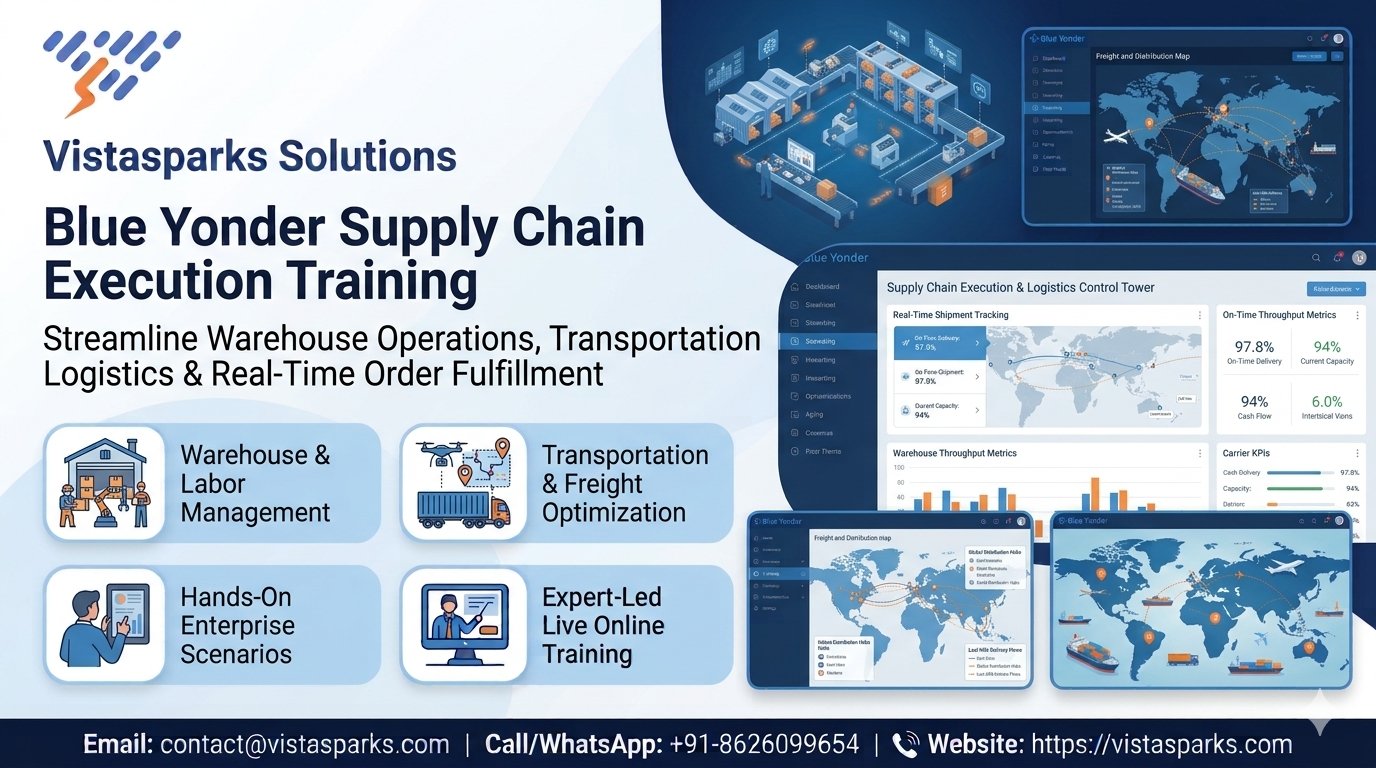
The training covers important supply chain execution areas, including:
Supply chain execution fundamentals
Warehouse management and warehouse execution
Transportation management and shipment execution
Inventory and order fulfillment
Labor and workforce management
Logistics operations and carrier coordination
Shipment tracking and delivery visibility
Exception management and operational reporting
Supply chain integration and process optimization
The exact product capabilities and workflows covered can vary depending on the Blue Yonder solution, version, and business configuration.
Understanding supply chain execution
Supply chain planning vs. execution
Supply chain execution lifecycle
Key business processes
Role of Blue Yonder in supply chain operations
Benefits of integrated supply chain execution
Introduction to the Blue Yonder Platform
Platform architecture and components
Application navigation
User roles and responsibilities
Master data concepts
Basic system configuration concepts
Warehouse management fundamentals
Warehouse structure and configuration
Inbound and outbound processes
Receiving and putaway
Picking, packing, and shipping
Inventory movement and warehouse operations
Warehouse performance monitoring
Introduction to warehouse execution
Task creation and prioritization
Work assignment and task management
Picking route optimization
Replenishment task coordination
Workforce and equipment utilization
Warehouse execution monitoring
Inventory tracking and visibility
Stock movement and adjustments
Inventory allocation
Cycle counting
Inventory accuracy
Stock availability monitoring
Inventory exception handling
Transportation management fundamentals
Shipment planning and execution
Carrier management
Transportation scheduling
Load planning and optimization
Freight management concepts
Transportation cost monitoring
Order processing fundamentals
Order allocation
Order prioritization
Fulfillment workflows
Picking and packing coordination
Shipment confirmation
Order status tracking
Logistics operations
Distribution center management
Inbound and outbound logistics
Delivery coordination
Carrier collaboration
Logistics network visibility
Distribution performance monitoring
Introduction to labor management
Workforce planning and scheduling
Labor allocation
Task performance monitoring
Productivity measurement
Workload balancing
Labor performance reporting
Shipment tracking fundamentals
Transportation status updates
Delivery monitoring
Proof of delivery
Shipment exception management
Delay identification
Real-time logistics visibility
Integration between planning and execution
Warehouse and transportation integration
Order management integration
Master data synchronization
Data exchange concepts
Third-party system integration
End-to-end process coordination
Supply chain execution dashboards
Warehouse performance reports
Transportation performance reports
Inventory reports
Order fulfillment reports
Operational KPIs
Performance analysis and improvement
Identifying operational exceptions
Shipment delays
Inventory discrepancies
Warehouse execution issues
Transportation disruptions
Corrective actions
Exception monitoring and resolution
Warehouse receiving scenarios
Inventory movement exercises
Order fulfillment workflows
Shipment execution scenarios
Transportation coordination exercises
Exception handling practice
End-to-end supply chain execution case studies
Understand end-to-end supply chain execution processes.
Explain the role of Blue Yonder in logistics operations.
Understand warehouse management and execution workflows.
Manage inventory movement and stock visibility concepts.
Understand transportation and shipment execution.
Work with order fulfillment processes.
Understand labor and workforce management.
Monitor logistics activities and operational exceptions.
Analyze supply chain execution reports and KPIs.
Understand integration between planning and execution systems.
Industry-oriented training curriculum
Practical, real-world business scenarios
Step-by-step concept explanation
Warehouse and transportation workflows
Inventory and order fulfillment concepts
Reporting and analytics fundamentals
Interview preparation and career guidance
Guidance from experienced trainers
Our individual training program is suitable for students, freshers, and working professionals who want to develop their supply chain execution skills.
Key Benefits:
Personalized learning sessions
Flexible training schedules
Beginner-to-advanced concepts
Practical business examples
Doubt-clearing sessions
Interview preparation support
Career-oriented guidance
1. Career-Focused Learning
Develop knowledge of modern supply chain execution processes and enterprise applications.
2. Practical Knowledge
Understand warehouse, transportation, inventory, and logistics workflows through practical examples.
3. Industry-Relevant Skills
Learn concepts used in supply chain, distribution, warehousing, and logistics operations.
4. Flexible Learning
Choose training schedules that suit your professional or academic commitments.
5. Expert Guidance
Learn important concepts with guidance from experienced trainers.
6. Career Growth
Build a foundation for opportunities in supply chain management, logistics operations, warehouse management, and functional consulting.
Vistasparks Solutions also provides corporate training programs for organizations that want to improve their employees’ knowledge of Blue Yonder Supply Chain Execution.
Corporate Training Benefits:
Customized training curriculum
Role-based learning programs
Business-process-oriented training
Practical supply chain scenarios
Flexible online training sessions
Employee skill development
Improved operational understanding
Training aligned with organizational requirements
Online Instructor-Led Training
One-to-One Training
Corporate Training
Weekend Training
Weekday Training
Customized Training Programs
Enhance your supply chain and logistics knowledge with Blue Yonder Supply Chain Execution Training from Vistasparks Solutions.
Contact Vistasparks Solutions
📧 Email: contact@vistasparks.com
📞 Call/WhatsApp: +91-8626099654
🌐 Website: https://vistasparks.com
Enroll today and build your career in Supply Chain Execution, Logistics, and Warehouse Management!
Blue Yonder Supply Chain Execution Training
Blue Yonder Production Planning is a supply chain planning capability that helps organizations plan manufacturing activities, manage production capacity, coordinate material availability, optimize production schedules, and improve manufacturing efficiency.
The main purpose is to ensure that the right products are manufactured at the right time with available materials, resources, and production capacity while minimizing operational costs and production delays.
Students, freshers, production planners, manufacturing professionals, supply chain specialists, demand planners, inventory analysts, procurement professionals, ERP consultants, and IT professionals can join this training.
Basic knowledge of manufacturing processes, supply chain management, inventory management, production planning, or ERP systems is helpful. Beginners can also start with the fundamentals.
The training covers production planning fundamentals, demand planning, material requirements planning (MRP), production scheduling, capacity planning, resource management, inventory coordination, configuration concepts, reporting, integrations, and implementation scenarios.
Material Requirements Planning (MRP) is a process used to calculate the materials and components required for production based on demand, inventory availability, and planned production schedules.
A Bill of Materials (BOM) is a structured list of raw materials, components, and subassemblies required to manufacture a finished product. It helps organizations calculate material requirements and plan production activities.
Production scheduling involves organizing manufacturing activities, assigning production orders, allocating resources, sequencing jobs, and determining when production operations should take place.
Capacity planning is the process of determining whether available machines, labor, equipment, and production resources are sufficient to meet manufacturing requirements.
It helps manufacturing companies improve production schedules, optimize resource utilization, coordinate material requirements, identify capacity constraints, reduce production delays, and improve operational efficiency.
Production planning determines what products need to be manufactured, how much to produce, and what resources are required. Production scheduling determines when and in what sequence manufacturing activities should take place.
Work-in-Progress (WIP) inventory refers to products that have started the manufacturing process but are not yet completed. Managing WIP helps organizations monitor production progress and inventory utilization.
Bottleneck management identifies production resources or processes that restrict overall manufacturing capacity. It helps organizations improve workflows, allocate resources, and reduce production delays.
The training introduces ERP systems, Manufacturing Execution Systems (MES), Warehouse Management Systems (WMS), procurement applications, supply chain planning systems, API-based integrations, and EDI communication.
Depending on the solution and configuration, organizations can analyze production schedules, material requirements, capacity utilization, inventory levels, production efficiency, resource performance, and manufacturing KPIs.
Resource allocation involves assigning available machines, labor, equipment, and production facilities to manufacturing activities to ensure efficient production operations.
Participants learn through production scheduling exercises, material shortage scenarios, capacity planning activities, manufacturing coordination, inventory management, production optimization, and real-time business case studies.
Candidates can explore opportunities such as Production Planner, Production Planning Analyst, Manufacturing Analyst, Supply Chain Analyst, Material Planner, Production Scheduling Analyst, Blue Yonder Functional Consultant, and Implementation Consultant, depending on their experience and skills.
Yes, Vistasparks Solutions provides interview preparation support, mock interview sessions, resume-building assistance, and practical project guidance as part of its training support.
Vistasparks Solutions offers instructor-led sessions, practical-oriented learning, experienced trainer guidance, real-time manufacturing scenarios, flexible training options, interview preparation, resume assistance, and career support to help participants develop production planning and supply chain management skills.
There are no reviews yet. Be the first one to write one.